
The premise is deceptively simple—place floors, accumulate winnings, cash out before disaster strikes—yet the execution reveals layers of tension that keep sessions engaging far longer than you'd expect from such minimalist mechanics. With an RTP of 98.5%, betting limits from £0.01 to £100, and a maximum win of £10,000, Tower Rush occupies an interesting middle ground: accessible enough for cautious beginners, volatile enough to satisfy players who chase significant multipliers. This review examines how the game actually performs across extended sessions, where the bonus floors make a tangible difference, and whether Galaxsys has genuinely refined the crash formula or simply repackaged familiar mechanics with a construction theme.
Tower Rush: key facts
| Provider | Galaxsys |
|---|---|
| Type | Crash / Tower-building game |
| RTP | 98.5% |
| Volatility | High |
| Min / max bet | £0.01 / £100 |
| Max win | £10,000 |
| Mobile | Yes |
| Demo | Yes |
A well-executed crash game that trades speed for strategic pacing, offering transparent mechanics and one of the highest RTPs in the category, though the tower theme adds little beyond visual polish.
What is Tower Rush?
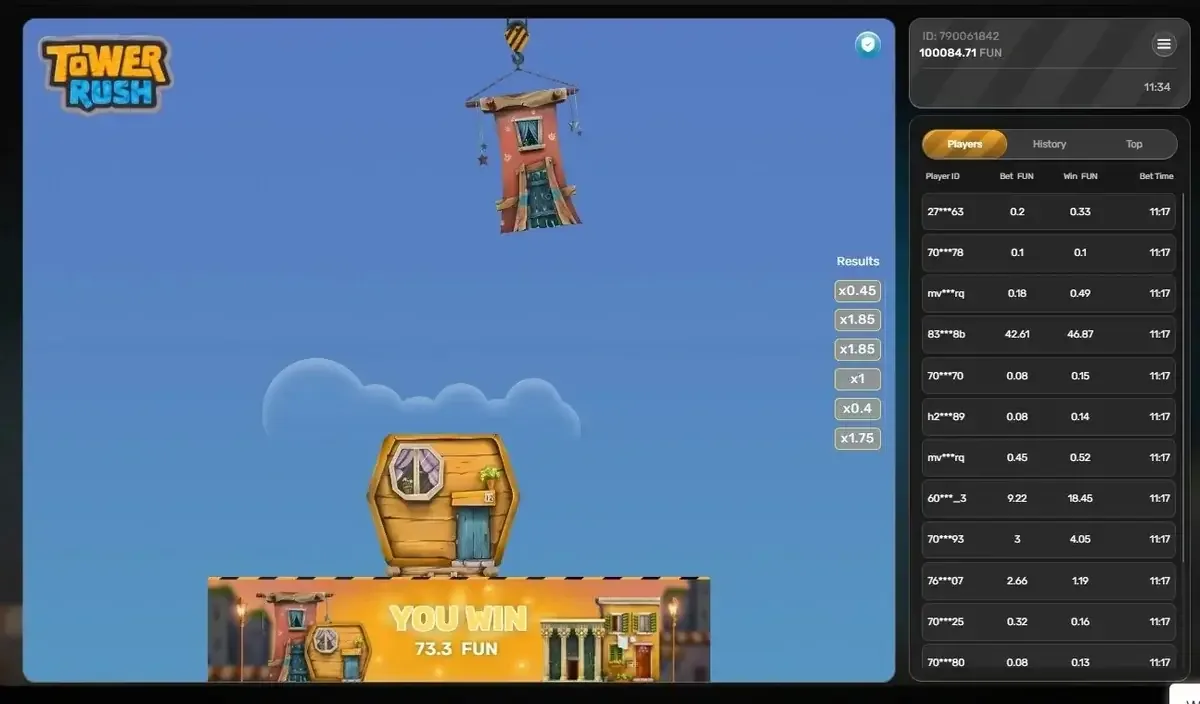
Tower Rush is a crash-style mini-game where outcomes depend entirely on your timing rather than symbol combinations or bonus triggers. You place a bet, then decide floor by floor whether to continue building upward—increasing your multiplier with each successful placement—or cash out and bank your accumulated winnings. The tower can collapse at any moment, ending the round and forfeiting everything you've built. This creates the signature tension of crash games: every decision to place another floor is a calculated gamble between growing profit and total loss.
Galaxsys positions Tower Rush within the broader crash and mines category, alongside games like Crash, Mines, and other timing-based titles where player intervention determines the outcome. The tower-building metaphor is largely cosmetic—you're not selecting floor types or influencing construction—but it provides a satisfying visual framework for watching your multiplier ascend. The game runs on provably fair technology, meaning the collapse point is determined at the start of each round using cryptographic hashing, though like all such systems, 'provably fair' guarantees mathematical transparency, not favourable results.
What distinguishes Tower Rush from faster crash games is pacing. Rather than a continuous ascending curve that can end in two seconds, you're making discrete decisions: place this floor, or stop here? This slower tempo suits players who prefer deliberate choices over reflex gambling, though it also means fewer rounds per hour compared to rapid-fire crash variants. The 98.5% RTP sits at the generous end for this category—most crash games hover between 96% and 98%—though as always, this figure represents theoretical long-term return across millions of rounds, not a guarantee for your next hundred.
How to play Tower Rush
1: Set your stake and initiate the climb
Select your bet amount using the stake controls, anywhere from £0.01 to £100 depending on your bankroll and risk appetite. Once you've confirmed your wager, you begin the round by placing the first floor. This initial placement activates the tower and starts your multiplier progression—from this point forward, you're committed to either building higher or cashing out, as there's no option to pause mid-climb. If you're testing the game or working out your preferred strategy, start with minimum stakes; the mechanics are identical at £0.01 and £100, but the former lets you explore the floor structure without meaningful financial exposure.
2: Place floors and watch the multiplier grow
After the first floor, each subsequent placement increases your multiplier according to the game's fixed payout table. Early floors deliver modest returns—the lower third of the tower tends to offer multipliers well below 2x—but the upper levels accelerate dramatically. The interface displays your current multiplier, accumulated winnings, and how many floors remain before you reach the theoretical maximum. The catch, of course, is that the tower can collapse on any floor. You don't see probabilities per floor, only the rising stakes: continue and potentially double your winnings, or trigger the collapse and lose everything. This is where bonus floors enter the equation—occasionally a Frozen Floor, Temple Floor, or Triple Build opportunity appears, altering the risk-reward calculation for that specific level.
3: Cash out or push for higher multipliers
At any point after placing your first floor, you can cash out and transfer your accumulated winnings to your balance immediately. The game doesn't penalise early exits or reward reckless climbing—your choice is purely strategic. Conservative players typically set auto-cashout at 2x or 3x multipliers, treating Tower Rush like a slightly volatile slot with frequent small wins. Aggressive players push toward the upper floors where multipliers reach double digits, accepting that most attempts will end in collapse but occasional successes deliver outsized returns. The key recognition: Tower Rush is a negative-expectancy game. The 98.5% RTP means the house retains 1.5% over time, so no strategy converts this into long-term profit. Your goal is entertainment value and the possibility of a significant win during your session, not systematic income.
How much can you win on Tower Rush?
The maximum win is capped at £10,000 or 10,000 times your bet unit, whichever arrives first. In practice, this ceiling becomes relevant only at higher stake levels—betting £10 or more per round—since reaching the theoretical maximum multiplier would otherwise exceed this limit. For players wagering £1 per climb, the £10,000 cap isn't a constraint; you're limited instead by how high you can build before the inevitable collapse.
The multiplier structure across the 36 floors isn't published in granular detail by Galaxsys, but testing and player reports suggest an exponential curve: the first dozen floors offer fractional increases, the middle section reaches 5x to 20x, and the upper floors spike into triple-digit territory if you're fortunate enough to reach them. Survival to floor 30 and beyond is rare, which is precisely why those multipliers exist—they compensate for the minuscule probability of getting there. A £1 bet that survives to the top tier could theoretically return £100 to £200, though most sessions will see you cashing out far earlier or losing the tower in the lower half.
- Minimum return: Cashing out after the first successful floor typically yields a multiplier below 1.5x, meaning you'll win £0.50 on a £1 bet—safe, but hardly thrilling.
- Mid-range returns: Reaching floors 10 to 15 before cashing out generally delivers 3x to 8x, which feels like the sweet spot for balancing risk and reward in regular play.
- High-end potential: Floors 20 and above enter volatile territory where multipliers can exceed 20x, but the collapse risk is sufficiently high that most attempts end in total loss before you cash out.
- Maximum win structure: The £10,000 cap means that at maximum stake (£100), you'd hit the ceiling at a 100x multiplier, far below the theoretical top of the tower—an important consideration for high rollers chasing the absolute peak payout.
Bonus floors and special features
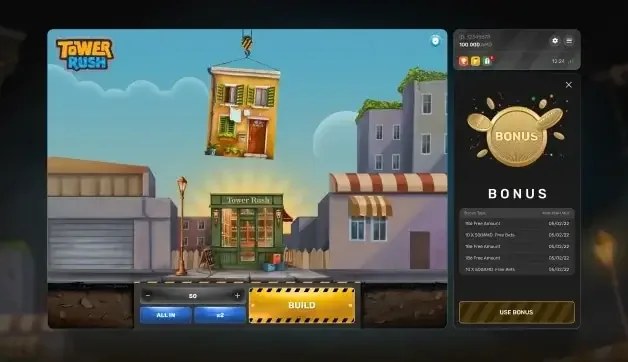
Tower Rush introduces three bonus floor types that appear randomly during climbs: Frozen Floor, Temple Floor, and Triple Build. These aren't triggered by scatter symbols or accumulated progress; they simply materialise on certain floors, altering the mechanics for that specific placement. The Frozen Floor locks your current win total, meaning if the tower collapses on the next floor, you don't lose everything—you keep the winnings frozen at that checkpoint. This is the most valuable bonus from a risk-management perspective, effectively giving you a free attempt at the next level. Temple Floor and Triple Build are less clearly defined in official materials, but player reports suggest Temple Floor offers enhanced multipliers for that level, while Triple Build lets you place three floors in one action, compressing risk into a single decision.
Do these bonuses materially change your expected return? Not really. The RTP of 98.5% already factors in the frequency and value of bonus floors, so while they create memorable moments—particularly when a Frozen Floor saves a high-value climb—they don't convert Tower Rush into a positive-expectancy game. What they do provide is variance. Sessions with frequent bonus floors feel more generous, while stretches without them can seem punishing, even though the long-run mathematics remain constant. If you're the sort of player who values gameplay texture over pure efficiency, the bonus floors add enough unpredictability to prevent Tower Rush from feeling like a repetitive climb-and-crash loop.
Strategies and good habits for Tower Rush
Use auto-cashout to enforce discipline
The auto-cashout function lets you predefine an exit multiplier—say, 3x or 5x—so the game automatically banks your winnings when you hit that level. This removes emotional decision-making from the equation, which is where most players haemorrhage money in crash games. Without auto-cashout, it's tempting to 'just one more floor' your way into a collapse, particularly after a string of low multipliers. Set your threshold based on your session goals: if you're playing conservatively, 2x to 3x ensures frequent small wins; if you're chasing bigger returns and can tolerate long losing streaks, 10x or higher might suit your risk profile. Test different thresholds in demo mode to see which feels sustainable over 50+ rounds.
Start with minimum stakes until you understand floor distribution
Tower Rush doesn't publish the exact probability curve for collapses, so your first dozen sessions are essentially reconnaissance. Bet £0.01 or £0.10 per round and observe where the tower typically fails. You'll notice patterns—not because the game is predictable, but because the underlying probability distribution becomes apparent through repetition. Once you've developed an intuition for how often you reach floor 10, floor 20, and beyond, you can calibrate your cashout strategy and stake sizing accordingly. Jumping in at £10 per round without this groundwork is financially inefficient; you're paying to learn lessons that cost pennies at minimum stake.
Treat bonus floors as variance, not strategy levers
When a Frozen Floor appears, it's tempting to view it as a signal to push higher, but this is a cognitive trap. Bonus floors are randomly distributed and their appearance doesn't alter the probabilities of subsequent floors. A Frozen Floor protects your current winnings if the next floor collapses, which is valuable, but it doesn't make the next floor safer—it just changes the consequence of failure. Use bonus floors as pleasant surprises that occasionally extend your climb, not as indicators to deviate from your planned cashout threshold. The same applies to Temple Floor and Triple Build: enjoy them when they arrive, but don't construct a strategy that depends on their frequency.
Set session limits and respect them
Crash games are structurally designed to encourage 'one more round' behaviour, and Tower Rush is no exception. The quick reset between rounds, the tantalising possibility of a high multiplier, and the sting of recent collapses all push you to keep playing. Decide before you start: how many rounds will you play, or what loss threshold ends the session? If you've set 100 rounds or a £50 loss limit, stop when you hit it, regardless of whether you're up or down. This isn't moral advice—it's practical bankroll management. Tower Rush has a 98.5% RTP, which means extended play statistically favours the house. Your best chance of finishing ahead is hitting a favourable variance spike and walking away, not grinding through hundreds of rounds expecting the RTP to work in your favour.
Demo mode versus real-money play
Tower Rush offers a demo mode where you climb with virtual currency, identical mechanics to the real-money version but zero financial risk. This is the correct place to start for any player new to crash games or unfamiliar with Galaxsys titles. You'll learn how floor placement works, test different auto-cashout thresholds, see how bonus floors behave, and develop a feel for the game's pacing—all without spending a pound. The demo doesn't impose round limits or time restrictions, so you can play 500 rounds if you want a statistically meaningful sample of how the tower behaves across multiple sessions.
The psychological gap between demo and real money is substantial, however. Demo rounds don't trigger the same decision-making pressure because there's no consequence to collapse. You'll find yourself pushing to absurd floors 'just to see what happens', which is useful for exploring the upper multiplier ranges but teaches bad habits for real-money play. Once you switch to actual stakes, even £0.10 per round, the temptation to extend climbs intensifies because real money is at risk. This is why it's worth playing demo mode seriously—set a pretend bankroll, enforce your cashout rules as if it were real, and observe whether you can maintain discipline over 100 rounds. If you can't stick to your plan with virtual currency, you certainly won't with actual funds.
For experienced crash-game players, demo mode is less essential. If you've played Aviator, JetX, or similar titles, Tower Rush is mechanically familiar; only the floor-by-floor pacing differs. You can reasonably jump into real-money play at minimum stakes and adapt on the fly. For everyone else—particularly players coming from traditional slots—spend at least 50 demo rounds understanding how crash mechanics differ from payline-based games before committing real money. The skill set isn't transferable, and assuming you can apply slot strategies to Tower Rush is an efficient way to lose your bankroll.
Our verdict on Tower Rush
Tower Rush executes the crash-game formula competently, offering transparent mechanics, one of the highest RTPs in the category, and enough pacing variation to distinguish itself from faster crash titles. The tower-building theme is largely ornamental—you're not making architectural decisions, just timing cashouts—but the visual clarity is excellent, and the floor-by-floor structure creates natural decision points that prevent the mindless button-mashing some crash games encourage. Galaxsys has clearly optimised for mobile play; the interface scales well to smaller screens, and the deliberate tempo suits touchscreen interaction better than games that demand split-second reactions.
The 98.5% RTP is the standout feature here. Most crash games sit at 97% or lower, so Tower Rush offers a measurably better theoretical return, which compounds over long sessions. Whether this translates to noticeably better results in a 200-round session is debatable—variance dominates short-term outcomes—but for players who treat RTP as a meaningful selection criterion, Tower Rush is objectively more generous than alternatives. The bonus floors add texture without introducing complexity, though they're not frequent enough to define the experience; most rounds are straightforward climb-and-crash affairs with occasional bonus interruptions.
Where Tower Rush falters slightly is differentiation. Strip away the tower visuals and you're left with a solid but unremarkable crash game. The floor structure slows the pace compared to Aviator, which some players will appreciate and others will find plodding. There's no multiplayer element, no leaderboards, no social features—you're climbing alone, which suits focused play but lacks the communal energy some crash games cultivate. For players who value mechanical clarity and strong RTP over novelty, Tower Rush delivers. For those seeking innovation or social engagement, it's competent but unexciting.
👍 Pros
- RTP of 98.5% is excellent for the crash-game category, offering better theoretical return than most competitors.
- Floor-by-floor pacing suits players who prefer deliberate decisions over reflex-based gambling, reducing the frantic energy of faster crash games.
- Bonus floors—particularly Frozen Floor—introduce enough variance to prevent the gameplay from feeling monotonous over extended sessions.
- Demo mode with no restrictions lets you test strategies and understand floor distribution before committing real money.
- Auto-cashout and auto-bet features support disciplined play and systematic strategy testing without manual intervention.
👎 Cons
- The tower-building theme is cosmetic; mechanically, this is a standard crash game with a vertical metaphor rather than a genuinely novel concept.
- Slower pacing means fewer rounds per hour compared to rapid crash games, which may frustrate players who prefer high-frequency action.
- Bonus floors appear infrequently enough that many sessions feel like pure climb-and-crash loops without meaningful feature variation.
- No multiplayer, leaderboards, or social features—you're playing in isolation, which lacks the communal engagement some crash games offer.
- Maximum win of £10,000 constrains high-stakes players at maximum bet levels, capping potential returns well below the tower's theoretical peak multipliers.
Frequently asked questions
What RTP does Tower Rush offer?
Tower Rush operates at 98.5% RTP, which is strong for the crash-game category—most alternatives range from 96% to 98%. This percentage represents the theoretical return to players across millions of rounds, not a guarantee for individual sessions. In practical terms, you'll lose 1.5% of your total wagered amount over extended play, though short-term variance means individual sessions can deviate wildly from this average.
How do bonus floors work in Tower Rush?
Bonus floors—Frozen Floor, Temple Floor, and Triple Build—appear randomly during climbs and alter the mechanics for that specific level. Frozen Floor is the most valuable: it locks your current winnings, so if the tower collapses on the next floor, you keep the frozen amount rather than losing everything. Temple Floor and Triple Build are less clearly documented but appear to offer enhanced multipliers or compressed floor placement. These bonuses are already factored into the 98.5% RTP, so they create memorable moments but don't change your long-term expected return.
Can you use strategy to beat Tower Rush?
No strategy converts Tower Rush into a positive-expectancy game. The 98.5% RTP means the house retains 1.5% over time, regardless of your cashout thresholds, stake sizing, or betting patterns. What you can do is manage variance: conservative auto-cashout settings (2x to 3x) deliver frequent small wins with lower volatility, while aggressive settings (10x or higher) produce long losing streaks punctuated by occasional large wins. Your strategy determines your experience and short-term results, but all approaches converge on the same negative expectancy over thousands of rounds.
Is Tower Rush available on mobile devices?
Yes, Tower Rush is fully optimised for mobile play and works on iOS and Android devices through your browser—no app download required. The floor-by-floor pacing suits touchscreen interaction better than faster crash games that demand split-second timing, and the interface scales cleanly to smaller screens. You'll find the same features, RTP, and betting limits on mobile as on desktop, with no functionality compromised.
Should beginners start with demo mode?
Absolutely, particularly if you're unfamiliar with crash-game mechanics. Demo mode gives you unlimited rounds with virtual currency, letting you learn how floor placement works, test auto-cashout thresholds, observe bonus floor frequency, and develop an intuition for where the tower typically collapses—all without financial risk. Spend at least 50 rounds in demo mode treating it like real money: set a pretend bankroll, enforce your cashout rules, and see whether you can maintain discipline. If you can't stick to your plan with virtual currency, you'll struggle with actual stakes.