
Unlike traditional slots where outcomes resolve in milliseconds, Chicken Road 2 hands you control over risk exposure. Four difficulty settings—Easy, Medium, Hard and Hardcore—determine lane count and traffic density, letting you tailor volatility before each round begins. A live wins feed streams recent payouts from other players, reinforcing the social dimension of a game that otherwise operates as a solitary test of nerve. This review examines the multiplier structure, difficulty framework, interface design and practical strategies for navigating InOut's traffic grid without turning your stake into roadkill.
Chicken Road 2: key facts
| Provider | InOut Games |
|---|---|
| Type | Browser-based traffic mini-game |
| RTP | Not disclosed |
| Volatility | Player-selectable (four tiers) |
| Min / max bet | £0.50 minimum (upper limit set by operator) |
| Max win | Not disclosed by provider |
| Mobile | Browser-compatible across devices |
| Demo | Yes |
A skilfully executed twist on crash mechanics, offering transparent multiplier steps and genuine player agency through difficulty selection.
What is Chicken Road 2?
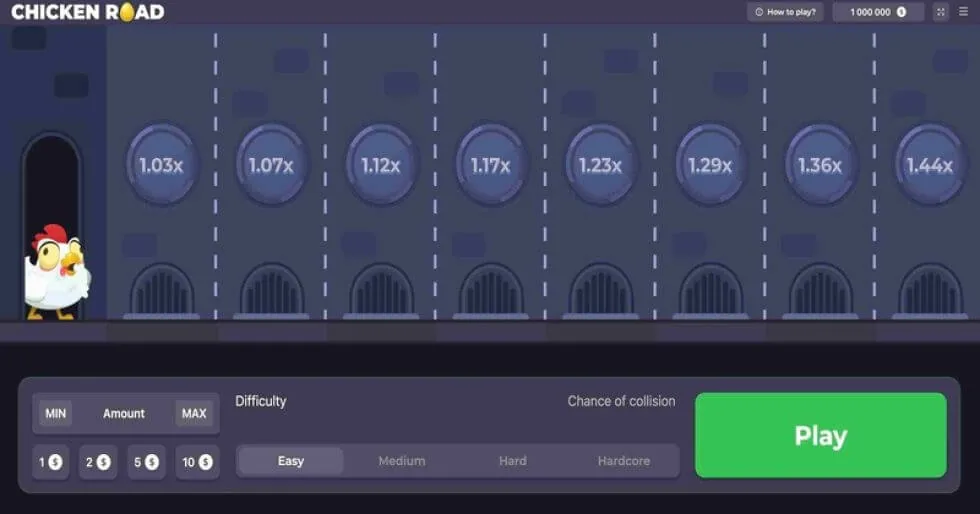
Chicken Road 2 belongs to the crash genre of casino mini-games, where outcomes unfold in real time rather than spinning to a predetermined result. You control a white chicken avatar positioned at the bottom of a multi-lane road. Turquoise cars glide horizontally across each lane at varying intervals, and your task is to advance the chicken upward through the traffic grid without being struck. Every lane cleared applies a multiplier to your initial wager, compounding as you progress. Circular manhole graphics on each lane display your current multiplier, so you always know the exact payout awaiting collection.
The game diverges from its sibling title, Chicken Road, through revised scenery and altered traffic patterns whilst retaining the core lane-crossing mechanic. InOut has refined the visual presentation: the chicken avatar features anatomically precise detail, including a five-pointed crimson comb, teardrop wattle, triangular orange beak and shadowed grey wings. A gentle idle animation cycles roughly every two seconds, lending the character a lifelike waiting posture. The interface opens on Medium difficulty by default, presenting 25 lanes and moderate traffic density—a balanced entry point for players unfamiliar with the format.
Browser execution eliminates download requirements. The game adapts to desktop and mobile screens, maintaining a crisp 1920×1080 resolution on larger displays. Currency handling is flexible, though the interface defaults to US dollars; partner casinos typically convert stakes into pounds sterling at current exchange rates. A live wins ticker runs along the top edge, displaying recent payouts alongside an online user counter. This social layer reassures players that genuine withdrawals occur across the network, though it exerts no influence on your own round outcomes.

How to play Chicken Road 2?
1: Select Your Stake and Difficulty
Before launching a round, choose your wager from the circular bet selectors at the base of the screen. Preset options include £0.50, £1, £2 and £7, though some operators permit manual entry for intermediate amounts. Next, open the difficulty menu and pick one of four tiers: Easy (30 lanes, sparse traffic), Medium (25 lanes, moderate density), Hard (22 lanes, increased collision risk) or Hardcore (18 lanes, maximum pressure). The difficulty setting governs lane count and traffic flow but does not alter individual multiplier values. Medium offers a sensible starting point, striking a balance between payout scope and survivability.
2: Navigate the Lanes and Monitor Multipliers
Click the green Play button to place your chicken at the starting line. Traffic begins moving immediately, so watch for gaps between the turquoise cars. Click or tap the road ahead to advance the chicken one lane forward. Each successful crossing applies the lane's fixed multiplier to your cumulative total, compounding with every step. The circular manhole icon on each lane updates in real time, showing your active payout factor. If you enable the 'Space to spin and go' option in settings, pressing the Space key replaces mouse clicks, allowing faster, more rhythmic progression—useful once you've internalised traffic patterns.
3: Cash Out Before Collision
At any moment before entering the next lane, you may collect your winnings by selecting the cash-out control. Doing so locks in your current multiplier and credits your balance immediately. Delaying the withdrawal compounds your payout further but exposes you to collision risk: if the chicken touches a moving car, the round ends instantly and your stake is lost. The tension between advancing for higher multipliers and securing a modest but guaranteed profit defines every decision. Higher difficulty tiers compress this calculus by offering fewer lanes and denser traffic, forcing quicker choices under tighter margins.
How Much Can You Win on Chicken Road 2?
Chicken Road 2's payout structure is transparent and entirely multiplier-driven. Lane one applies a 1.01× factor, lane two raises it to approximately 1.02×, and the progression continues in small increments until lane six delivers the peak single-lane boost of 1.19×. Because these multipliers compound, reaching lane six means you've accumulated the product of all prior factors, not merely the final 1.19× value. The exact multiplier at any given lane depends on how many steps you've completed, and the circular manhole markers provide a live readout so you're never guessing.
The maximum win ceiling is not disclosed by InOut, a common practice among crash-style games where theoretical upper limits depend on lane count and compounding depth. On Easy mode's 30-lane grid, surviving the full journey would stack multipliers into a substantial total, though traffic density ensures reaching the final lane remains statistically rare. Hardcore mode's 18-lane limit caps your maximum multiplier sooner but compensates with tighter traffic, raising the likelihood of an early collision. In practice, most players cash out between lanes eight and fifteen, balancing compounded gains against escalating risk.
It bears repeating that all casino mini-games, including Chicken Road 2, are designed to favour the house over extended play. The absence of published RTP figures makes it impossible to quantify the house edge precisely, though the compounding multiplier structure and player-controlled volatility suggest a model closer to skill-based arcade games than pure chance slots. Even so, outcomes remain probabilistic: crossing a lane successfully in one round offers no statistical advantage in the next. Responsible gambling guidelines apply, and players should set loss limits before starting any session.
- Lane one applies a 1.01× multiplier; lane six peaks at 1.19×.
- Multipliers compound with each successful crossing, not replacing prior values.
- Easy mode offers 30 lanes; Hardcore restricts you to 18, capping maximum payout depth.
- No disclosed RTP; long-term outcomes favour the operator as with all casino games.
- Live wins feed confirms recent payouts but does not influence your round probabilities.
Strategies and Sensible Habits
Start on Medium Difficulty to Learn Traffic Rhythms
Jumping straight into Hardcore mode without prior experience invites rapid losses. Medium difficulty presents 25 lanes and moderate traffic density, giving you enough runway to observe car movement patterns and reaction-time requirements. Spend your first few demo rounds focusing on traffic flow rather than chasing high multipliers. Once you can consistently reach lane ten without collision, consider stepping up to Hard mode. Easy mode's 30 lanes and sparse traffic may feel too forgiving for players seeking meaningful challenge, but it serves as a useful training ground for absolute beginners.
Set a Cash-Out Target Before Each Round
Impulse decisions during live play lead to avoidable collisions. Before clicking Play, decide on a specific multiplier threshold—say, 1.10× or 1.15×—and commit to cashing out once you reach it. This pre-commitment removes emotional pressure when traffic intensifies mid-round. Greed is the game's silent opponent: chasing 'just one more lane' after hitting your target often results in losing the entire stake. If you reach your goal early, collect the winnings and start a fresh round. Discipline here compounds profitability over multiple sessions far more effectively than a single lucky streak.
Use Keyboard Control for Faster Reactions
The 'Space to spin and go' setting in the options menu replaces mouse clicks with a single keystroke, reducing input lag and allowing quicker lane crossings. This becomes critical on Hard and Hardcore tiers, where traffic gaps shrink and hesitation costs you the round. Keyboard control also maintains consistent hand positioning, preventing the micro-movements that disrupt timing when using a mouse or touchscreen. Practise in demo mode until the Space key input feels instinctive; the rhythm should become second nature before you risk real stakes on the tightest difficulty settings.
Free Demo or Real Money?
Chicken Road 2 offers unrestricted demo access directly in-browser, requiring neither account registration nor payment-method entry. The demo uses virtual currency that resets automatically, letting you test difficulty tiers, practise traffic timing and observe multiplier progression without financial exposure. This is the correct starting point for any new player: real-money rounds introduce psychological pressure that alters decision-making, and inexperienced players who skip the demo phase typically burn through their bankroll within minutes.
Once you've mastered Medium difficulty and can cash out reliably at your chosen multiplier threshold, consider switching to real-money mode through a reputable online casino. Partner operators integrate Chicken Road 2 into their mini-games or crash sections, often alongside titles like Aviator and JetX. Verify that the casino holds a UK Gambling Commission licence before depositing; unlicensed sites lack consumer protections and may withhold winnings arbitrarily. Real-money play unlocks the live wins feed and online user counter, adding a social dimension absent from solo demo sessions.
Bear in mind that real-money outcomes carry identical odds to demo rounds—the game does not become 'looser' or 'tighter' based on mode. The house edge remains constant, and extended play will erode your balance over time regardless of skill level. Set a session budget in advance, treat any winnings as a bonus rather than income, and never chase losses by increasing stakes after a collision. The demo exists precisely to insulate you from these financial pressures; use it liberally.
Our Opinion on Chicken Road 2
Chicken Road 2 executes the crash formula with uncommon transparency and player respect. The compounding multiplier structure is laid bare through real-time manhole markers, eliminating guesswork about current payout levels. Four difficulty tiers let you calibrate volatility before each round rather than discovering it mid-session, a courtesy rarely extended in traditional slots. The white chicken avatar, rendered with anatomical care and subtle idle animation, injects personality into what could have been a sterile grid of lanes and cars. InOut's attention to visual detail and interface polish elevates the experience above the genre's typical offerings.
The absence of disclosed RTP figures remains a frustration, though this omission is endemic to crash-style games and reflects broader industry practice rather than a specific failing of Chicken Road 2. Player-controlled progression mitigates some of this opacity: you decide when to cash out, and the multiplier logic is entirely visible, so outcomes feel less opaque than slot spins resolved by hidden algorithms. The live wins feed and online user counter foster a sense of community, though sceptical players should remember these elements serve partly as marketing devices to demonstrate payout legitimacy. Still, the transparency around multiplier mechanics and traffic patterns makes Chicken Road 2 one of the fairer entries in a genre often criticised for inscrutability.
👍 Pros
- Transparent multiplier progression with real-time visual feedback on every lane
- Four difficulty tiers allow precise volatility control before each round
- Polished interface with detailed chicken avatar and smooth animations
- Unrestricted demo mode requiring no registration or payment details
- Keyboard shortcut support for faster, more rhythmic lane crossings
👎 Cons
- No published RTP figures, leaving house edge uncertain
- Maximum win ceiling undisclosed, complicating bankroll planning
- Limited strategic depth compared to skill-based arcade titles
- Live wins feed may encourage impulsive play by showcasing large payouts
Frequently asked questions
Can I play Chicken Road 2 on my mobile phone?
Yes. Chicken Road 2 runs entirely in-browser and adapts to mobile screens without requiring a dedicated app. Touch controls replace mouse clicks, though some players find the keyboard shortcut more precise on desktop devices.
What is the difference between Chicken Road and Chicken Road 2?
Both games share InOut's authorship and lane-crossing mechanic, but Chicken Road 2 introduces revised scenery, altered traffic patterns and a different visual layout. The four difficulty tiers and multiplier structure remain consistent across both titles.
Do higher difficulty settings increase the multiplier values?
No. Hardcore, Hard, Medium and Easy modes alter lane count and traffic density but leave individual multiplier values unchanged. Harder tiers compress your maximum potential payout by offering fewer lanes, whilst simultaneously raising collision risk through denser traffic.
Is there a provably fair system in Chicken Road 2?
InOut has not published documentation confirming provably fair cryptographic verification. Even when such systems exist, they guarantee only that outcomes were not altered after the fact—they do not change the house edge or improve your odds of winning over extended play.
How do I know when to cash out?
Set a specific multiplier target before clicking Play—for example, 1.12× or 1.15×—and commit to cashing out once you reach it. Pre-commitment removes emotional pressure and prevents the common mistake of chasing 'just one more lane' after hitting your goal.